What is minimum vegetation clearance distance (MVCD) in utility vegetation management?
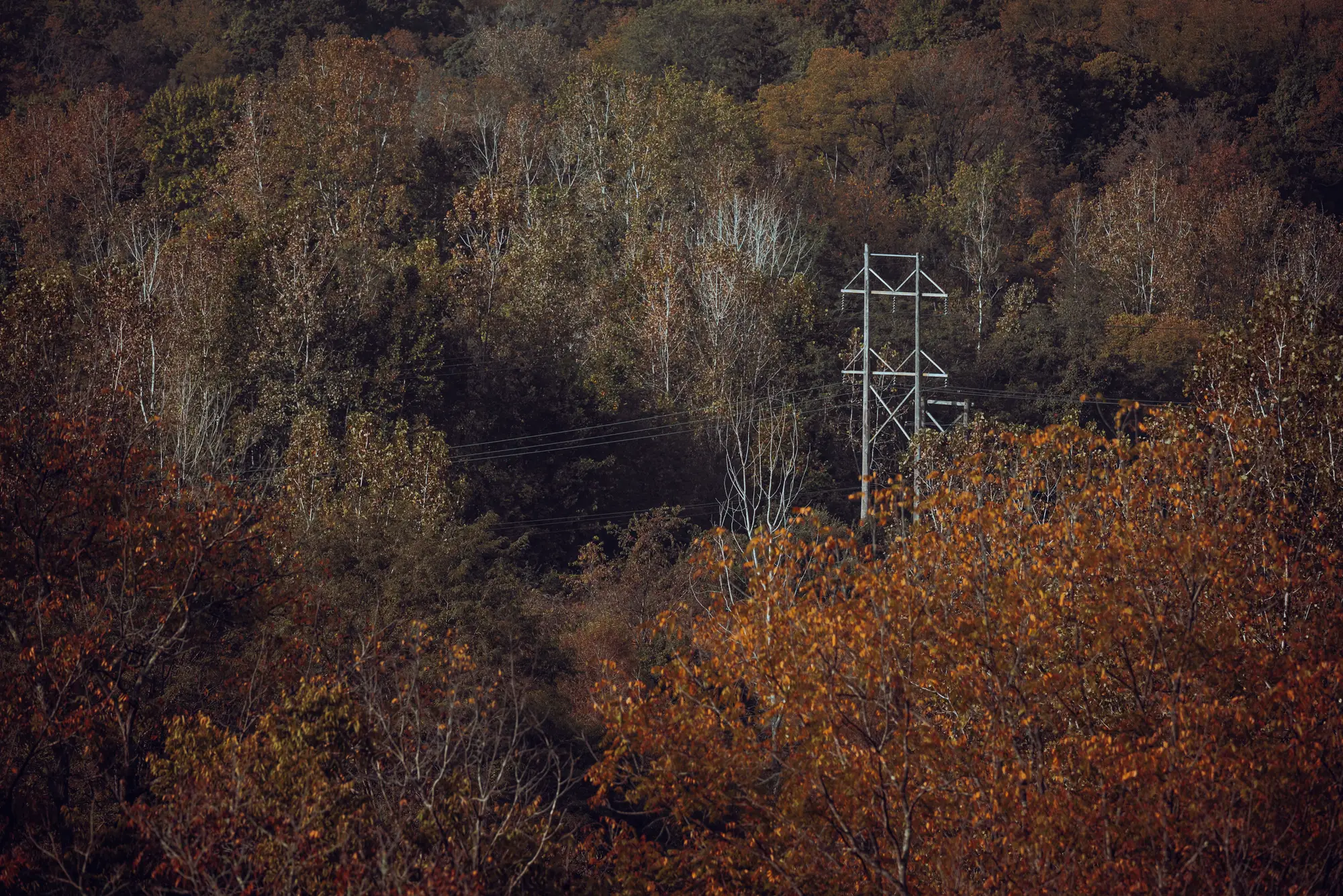
Minimum vegetation clearance distance, usually shortened to MVCD, is the smallest allowable gap between a conductor and the nearest vegetation at any point in the clearance cycle. It's a regulatory floor, not a trim target. Crews don't cut to MVCD, they cut to whatever buffer gets a span through to the next scheduled pass without falling below that floor on a hot, sagged, windy day.
The number itself comes from a handful of inputs: voltage class, conductor sag under max operating temperature, expected tree growth rate for the species on that span, and in a lot of states, a line clearance standard like ANSI A300 or a rule set out by the PUC. A 500 kV transmission line and a 12 kV distribution circuit don't share an MVCD, and neither do a fast-growing poplar stand and a slow oak canopy on otherwise identical spans. That's why MVCD tables in vegetation management plans read like voltage lookup charts rather than one flat number.
MVCD vs. wire-to-canopy clearance
MVCD is the rule. Wire-to-canopy clearance is the measurement you take against it. The two get used almost interchangeably in daily conversation, but they're not the same thing, and the gap between them is where most fall-in risk shows up first.
MVCD tells you the regulatory minimum, say 10 feet for a given voltage class. Wire-to-canopy clearance is the vertical and lateral distance between the conductor and the top of the canopy at a specific point on a specific span, measured today. A span can be sitting at 14 feet of clearance and legally compliant, and still be the one that goes first in a wind event if that canopy is growing 4 feet a year and the next scheduled trim is 18 months out. MVCD answers "is this span legal right now." Wire-to-canopy clearance, tracked over time, answers "is this span going to stay legal."
That distinction matters because most circuits aren't trimmed span by span based on measured clearance. They're trimmed on a cycle, every 3 to 5 years, regardless of whether a given span is near the floor or has years of buffer left. A cyclical schedule treats a span with 20 feet of clearance the same as one with 11 feet. One of those is a candidate for fall-in before the next scheduled visit. The other isn't close.
Why clearance drifts between inspections
Growth rate is species-specific and site-specific. A cottonwood on wet bottomland can put on several feet of height a year; a mesquite on a dry upslope span barely moves. Terrain, soil moisture, and sun exposure all shift growth within the same circuit, which is exactly why a blanket cycle misses spans that drift toward MVCD faster than average and wastes crew time on spans that don't need to be touched yet.
Conductor sag adds another variable crews have to account for that has nothing to do with the trees. Clearance measured on a cool, low-load day looks better than clearance under peak summer loading, when the line sags lower and the real gap shrinks. A span that clears MVCD comfortably in April can be tighter in August, same canopy, same wire, different sag.
Segmented canopy height, pulled from VHR imagery and checked against conductor position for every span on a circuit, gives you the wire-to-canopy number itself instead of a cycle-date guess. Powerline Vegetation Monitoring scores encroachment this way, span by span, keyed to your own span IDs, so the spans closest to MVCD surface as a ranked worklist instead of waiting for their turn in a blanket cycle.
If your circuit has thousands of spans and a trim budget that doesn't cover all of them this year, the ones worth sending a crew to first are the ones closing in on that minimum distance, not the ones next on the calendar.
Check how a scored, ranked worklist would change your next trim cycle.